Be Inspired, Not Influenced
May 29, 2026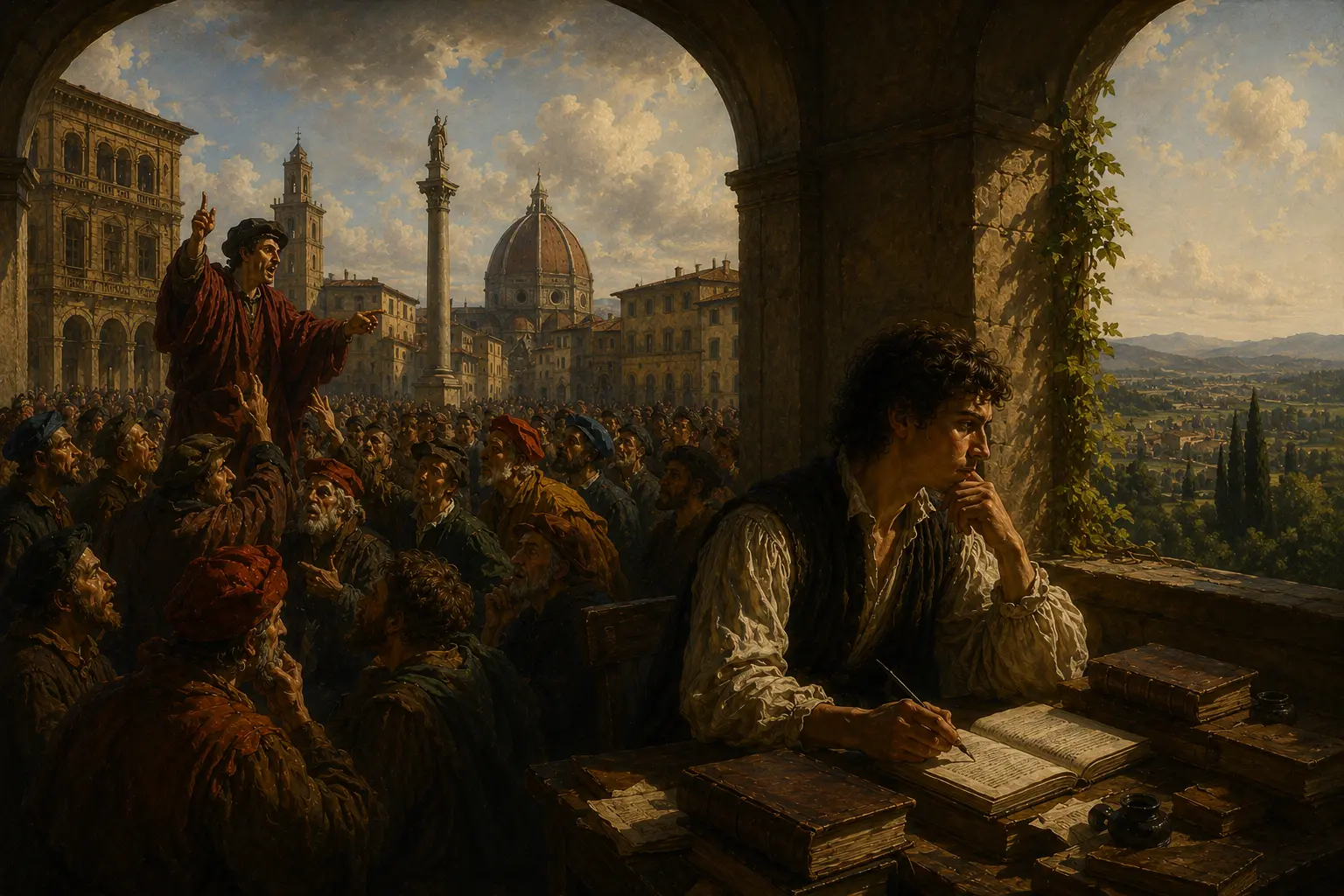
In 1909, E.M. Forster wrote a short story called The Machine Stops. In it, humanity lives underground, each person sealed in their own room, communicating only through a vast mechanical network that delivers ideas, lectures, and opinions on demand. Nobody goes outside. Nobody experiences anything firsthand. The Machine mediates everything. When a young man suggests to his mother that they ought to actually see the surface of the earth with their own eyes, she's appalled. Why would anyone do that when The Machine can simply tell you about it?
Forster meant it as a warning. I'm not sure we took it.
Usable Knowledge
Something has been bothering me for a while now, and I've only recently been able to get an idea of what it is. What I've noticed is that I gained far more usable knowledge as a kid than I have as an adult. Not raw information — I've consumed plenty of that. Usable knowledge. The kind that actually changes how you move through the world.
When I thought about what was different, it wasn't hard to identify. As a kid, my reading marched to the beat of my own drum. I followed curiosity wherever it led. As an adult, I've been driven almost entirely by the feeling that I should be reading this, or I should be following that person, or I should be doing what everyone seems to be doing. The yield on that investment has been, to be generous, negligible.
I don't think I'm alone in this.
There is surely something to be said for having the opportunity to be exposed to more novel concepts as a young person than as an adult, but that, I think, is akin to a curve. My situation felt more like a flatline plateau.
The Loudest Voice
There is a class of person who has proliferated enormously over the past decade. They are visible, confident, and almost always wrong in ways that take you a while to notice. I won't name names — it isn't necessary to prove the point, and it isn't fair. But I suspect most people reading this have had the experience of following someone who seemed to know exactly what they were talking about, only to eventually realize they didn't. Not even close.
The word "grifter" gets thrown around too freely these days, but some of them are that. Others are simply people who discovered that broadcasting certainty is far more rewarded than admitting uncertainty. Either way, the result is the same: you've handed your judgment over to a stranger.
Here's what I've come to believe about most real experts: they're too busy doing actual things to spend much time as influencers. Expertise and visibility have always been loosely correlated at best, but the internet has made that gap enormous. The loudest voice in the room is likely not the most informed one. Now the room is the entire world and the sound is deafening.
We've built a system that optimizes for the appearance of knowledge, and then we're surprised when it doesn't transfer into our lives.
No Correct Path
For years, I stagnated. Not visibly — I was busy, reading things, following people, absorbing content. But I wasn't going anywhere. I was searching for the correct path to put myself on, and that search consumed everything. What I didn't realize was that there isn't one correct path. There isn't a person online who has it mapped out for you. The more important thing — the only important thing, really — is to gain ground in the right direction.
My current view is that the path is something you follow for a while when you find it beaten down and clear, and then blaze yourself when it runs out. You push through the weeds and eventually cross another beaten path. Maybe it branched from the one you were on. Maybe it came from somewhere else entirely. Either way, you're moving.
In most cases, the danger isn't being on the wrong path. The danger is cessation of movement. It's sitting still, waiting for someone on the internet to tell you where to go next. "Learned helplessness" may be an applicable term.
Inspiration vs. Influence
There's a different way to use the internet — and inspiration, as opposed to influence, is the key distinction.
Inspiration makes you want to go do something, read something, build something, try something. Influence points you inward — at the influencer, at their products, at their worldview, at whatever they need you to believe to keep you coming back. One of these is generative. The other keeps you in the room.
Forster's characters weren't stupid. They were comfortable. The Machine gave them everything they thought they needed without ever requiring them to trust themselves. That's the seduction. That's what makes it hard.
But trusting yourself enough to investigate things firsthand — to follow your own curiosity rather than someone else's curriculum — is exactly the thing that compounds. It's slow. It doesn't feel like much at first. But it's yours, and it moves.
That's the only path worth being on.